Your greatest leverage may not be carrying more.
It may be developing the executive system capable of carrying the whole with you.

Unresolved complexity migrates upward.
Mission, quality, access, workforce, physician relationships, finance, board confidence, regulation, growth, technology, and future viability do not arrive already reconciled.
When the executive team has not developed sufficient collective capacity, the CEO becomes the integrator of last resort: translating functions, reconciling tradeoffs, preserving relationships, supplying coherence, and deciding what others could have learned to decide together.
The problem is not that the CEO integrates. Integration is intrinsic to the role. The problem is exclusive concentration.
Managing capable executives is not the same as developing a collective leadership system.
Managing capable executives
- Receives functional updates
- Resolves cross-functional conflicts
- Drives alignment around decisions
- Holds executives accountable for results
- Supplies enterprise coherence
Developing an Executive Human System™
- Commissions consequential shared work
- Develops integrated enterprise judgment
- Enables peers to work tensions directly
- Clarifies authority, ownership, and learning
- Builds distributed capacity to preserve coherence
Architect and developmental steward.
As architect, the CEO deliberately shapes the conditions through which the executive team functions.
As developmental steward, the CEO attends to the capacity from which the team exercises its competence—how it sees, interprets, relates, uses authority, works tension, and learns.
Real senior teams require consequential shared work and enabling conditions; they do not arise merely because accomplished people report to the same leader.3

Create the system that can see, decide, and learn across the whole.
These responsibilities form a practical model for shaping the executive system without reducing people to fixed parts or making the CEO responsible for every interaction.
Make explicit why this team exists beyond reporting and coordination. Name the consequential enterprise work that requires the full team, the stakeholders to whom it is accountable, and the outcomes it must hold together. Systemic team coaching and real-team research ground the importance of stakeholder commission, compelling direction, consequential shared work, and enabling conditions.5321
Distinguish functional work from genuinely collective work. Clarify whether the team is sensing, deciding, designing an experiment, coordinating dependencies, or learning from consequences. Hawkins, adaptive leadership, and complexity discernment support making purpose, authority, work type, and learning requirements explicit before the team rushes to solutions.52311
Create conditions in which incomplete truth, weak signals, doubt, and disagreement can travel early enough to be useful. Psychological safety, leader inclusiveness, and relational coordination support voice, learning, mutual respect, and problem-solving communication; they do not remove standards or consequences.4319
Keep the hospital’s consequential polarities in the room long enough to be worked—quality and cost, local and system, speed and learning, performance today and capacity tomorrow. Adaptive leadership and Action Inquiry support holding competing realities, regulating heat, and learning before premature closure eliminates useful difference.232417
Keep patients, families, clinicians, managers, community, board, mission, and future conditions present in executive interpretation. Systemic team coaching, relational coordination, leader inclusiveness, and sensemaking support reciprocal movement of meaning, information, authority, feedback, and learning across boundaries.593130
Deliver today while strengthening the leadership system that will carry tomorrow. The Quintuple Aim, clinician well-being research, collective leadership, and healthcare ethics reinforce responsibility for patient value, workforce vitality, equity, community, and future capacity—not present metrics alone.1012015
What continues to return to you for integration?
- Which tradeoffs are discussed collectively but resolved privately?
- Where do executives represent functions rather than integrate them?
- What important truth arrives later than it should?
- Which issue keeps returning under a different label?
- What would the team need to become capable of carrying without you?
“The CEO does not abdicate the whole. The CEO develops the executive team so the whole can be held by a stronger senior human system.”Executive Human System™ central proposition
Lead locally. Co-steward regionally.
A hospital CEO has two simultaneous commissions: lead the hospital and community with excellence, and contribute intelligently to the performance, mission, and future of the region.
Regional co-stewardship does not weaken local advocacy. It asks you to bring local reality without presenting it as the only reality; raise emerging risk early; share talent and learning when the whole requires it; lead work beyond the hospital; and translate regional intent into local operating reality without fragmenting it.
See the regional leadership system →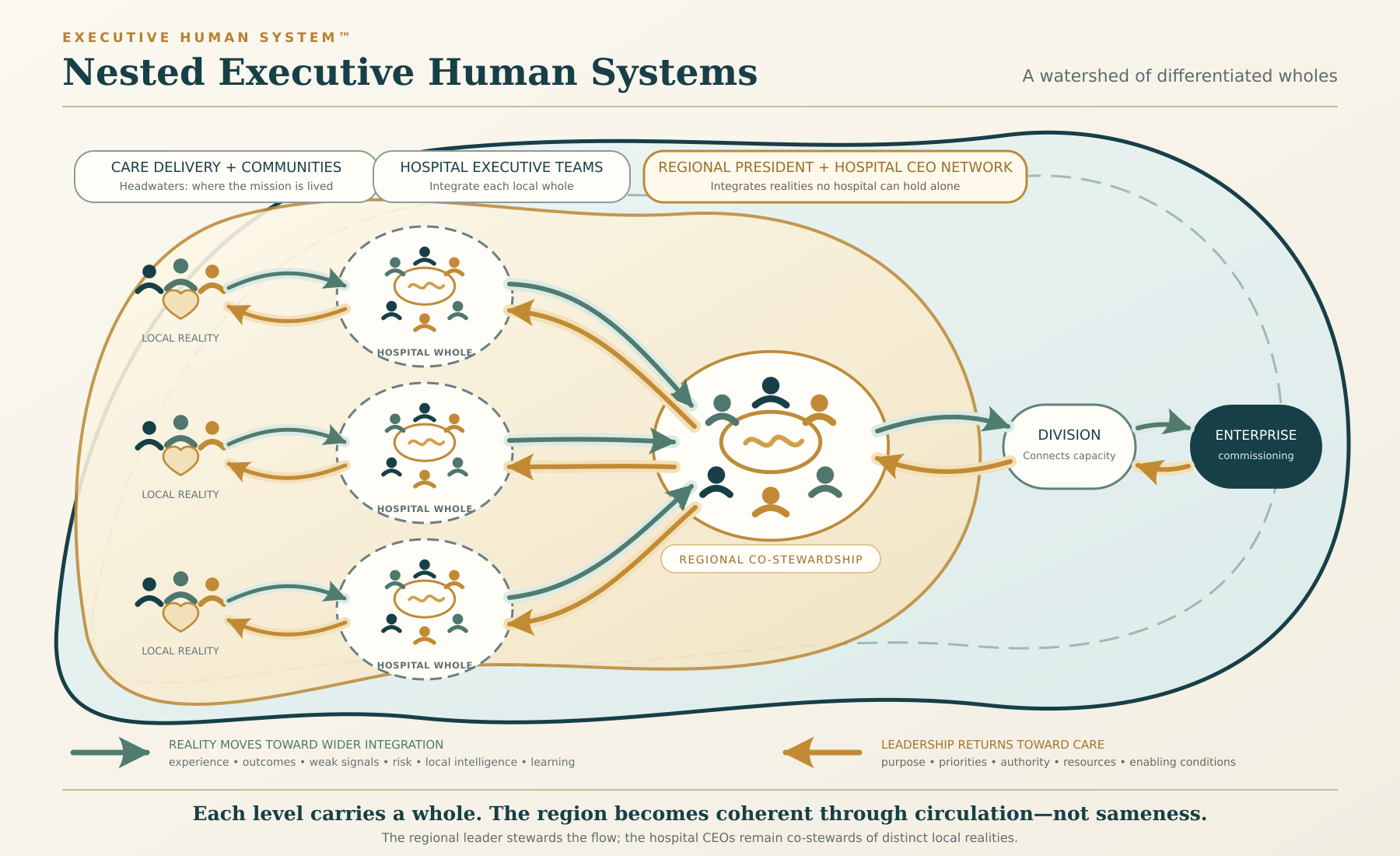
Is the team increasingly able to carry the whole with you?
Truth moves earlier
Weak signals, uncertainty, and disagreement become usable intelligence before they become crisis.
Tensions are worked together
Peers integrate consequential tradeoffs rather than relying automatically on CEO arbitration.
Authority is cleaner
People know what is theirs to decide, what requires coordination, and what legitimately belongs to the CEO.
Stakeholders remain present
Patient, workforce, community, mission, financial, and future consequences remain in the frame.
Outcomes become feedback
The team examines not only what happened, but how its own assumptions and leadership patterns contributed.
Coherence outlives the meeting
Meaning, decisions, ownership, and learning circulate into organizational life and return with less distortion.

Start with the enterprise work that already matters.
Confidential CEO diagnostic
Examine the leadership burden, recurring system patterns, and the team’s current capacity to carry the whole.
CEO trusted-advisor relationship
Work privately on authority, inner leadership, team architecture, and stewardship through live executive challenges.
Executive-team development
Diagnose, commission, engage live heat, experiment, learn, and embed stronger collective practices.