You are accountable for outcomes no hospital can produce alone.
Your unique leverage is not the sum of what hospital CEOs already do. It is developing the CEO network and regional leadership system through which local intelligence becomes coherent regional judgment, capacity, and action.

The organization chart shows where authority sits. It cannot show whether the region can move.
A region can contain strong hospitals, capable CEOs, clear reporting lines, shared scorecards, and substantial functional resources while remaining dependent on the regional president to connect the whole.
When important work lives primarily in one-to-one conversations, CEOs advocate locally without co-stewarding the region, and learning moves upward but not laterally, the leader becomes the hub through which integration must repeatedly pass.
The more competent the regional president becomes, the easier it is for the surrounding system to rely on that leader rather than develop collective regional capacity.
Research behind the network perspective
Notice whether…
A region is not a larger hospital. It is a watershed of differentiated human systems.
Each hospital carries a distinct community, history, physician landscape, workforce, market, capability, and local intelligence. Regional leadership protects those tributaries while creating a larger flow.
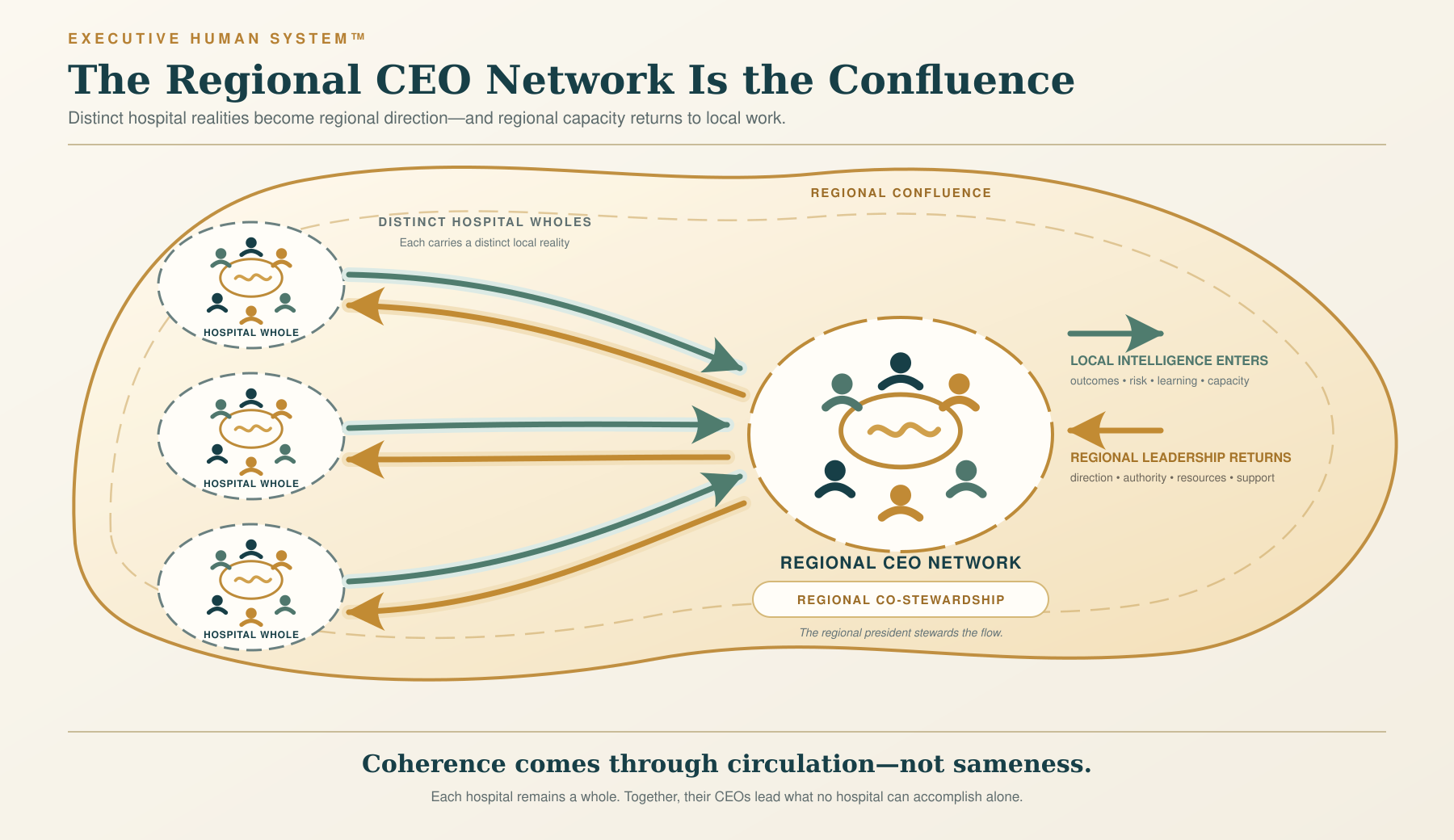
Research behind the living-system and network lens
Create what can exist only at regional altitude.
The region adds value when it becomes more than portfolio oversight and more than a larger coordination layer.
Shared mandate
Work and outcomes exceeding any individual hospital.
Coherent choices
Strategy, capital, talent, access, and capabilities held across markets and time horizons.
CEO network
Hospital CEOs capable of local advocacy and regional co-stewardship.
Leadership circulation
Information, risk, resources, talent, learning, and meaning moving in every direction.
Clear authority
Visible decision rights, escalation principles, and room for responsible adaptation.
Productive tension
Local differentiation and regional integration held without false choices.
CEO development
Leadership range expanded through consequential regional work.
Regional identity
Mission and coherence that preserve rather than erase local intelligence.
Can your CEO network carry the region?
This short scan helps you see where regional capacity is distributed—and where integration still depends disproportionately on you.
From portfolio oversight to an adaptive and regenerative regional system.
Maturity is not a ranking of leaders. It describes patterns of what the regional system can presently perceive, hold, decide, circulate, learn, and renew.
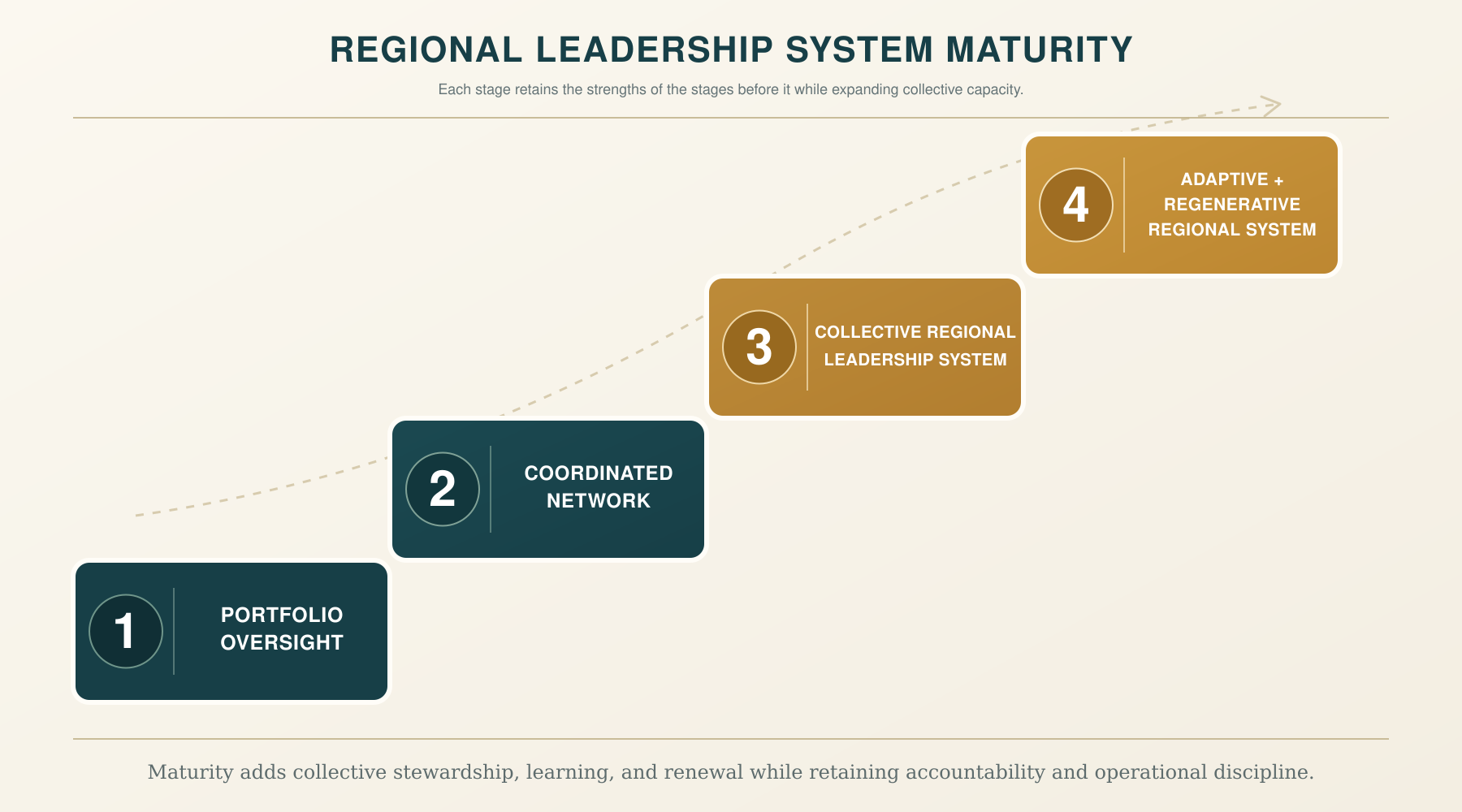
Remain accountable while increasing the system’s capacity to carry the work.
The regional president does not disappear into distributed leadership. The role becomes more deliberate about commission, authority, field-shaping, CEO development, circulation, and renewal.
Define why the CEO network exists, what it must accomplish together, which stakeholders it serves, and what authority it holds. A sequence of hospital reports is not yet a regional commission.
Distinguish enterprise, division, region, hospital, and shared work. Make decision rights, consultation, escalation, and bounded adaptation visible.
Attend to what the network notices, who carries ownership, what can be said before certainty exists, where energy resides, and what realities remain outside the room.
Hold local intelligence and regional coherence, performance and early truth, standards and adaptation, immediate results and future capacity—without premature consensus or private workarounds.
Use growth, access, capital, workforce, quality, clinical integration, and change as developmental experiences. Give CEOs opportunities to lead beyond their hospitals and reflect under heat.
Strengthen the relationships through which strategy, care, talent, resources, risk, information, and learning move across hospitals and organizational levels.
Build the region’s capacity to examine and redesign its own patterns, integrate growth, replenish leadership energy, prepare successors, and preserve mission through change.
Notice where integration travels.
When a cross-hospital issue appears, do the CEOs address one another directly—or does every line of interpretation and reconciliation return to you?
- Name the regional outcome.
- Ask each CEO what local reality the network must understand.
- Ask what belongs to the region and what should remain local.
- Clarify who decides, contributes, executes, and reviews.
- End with one bounded experiment and a learning date.
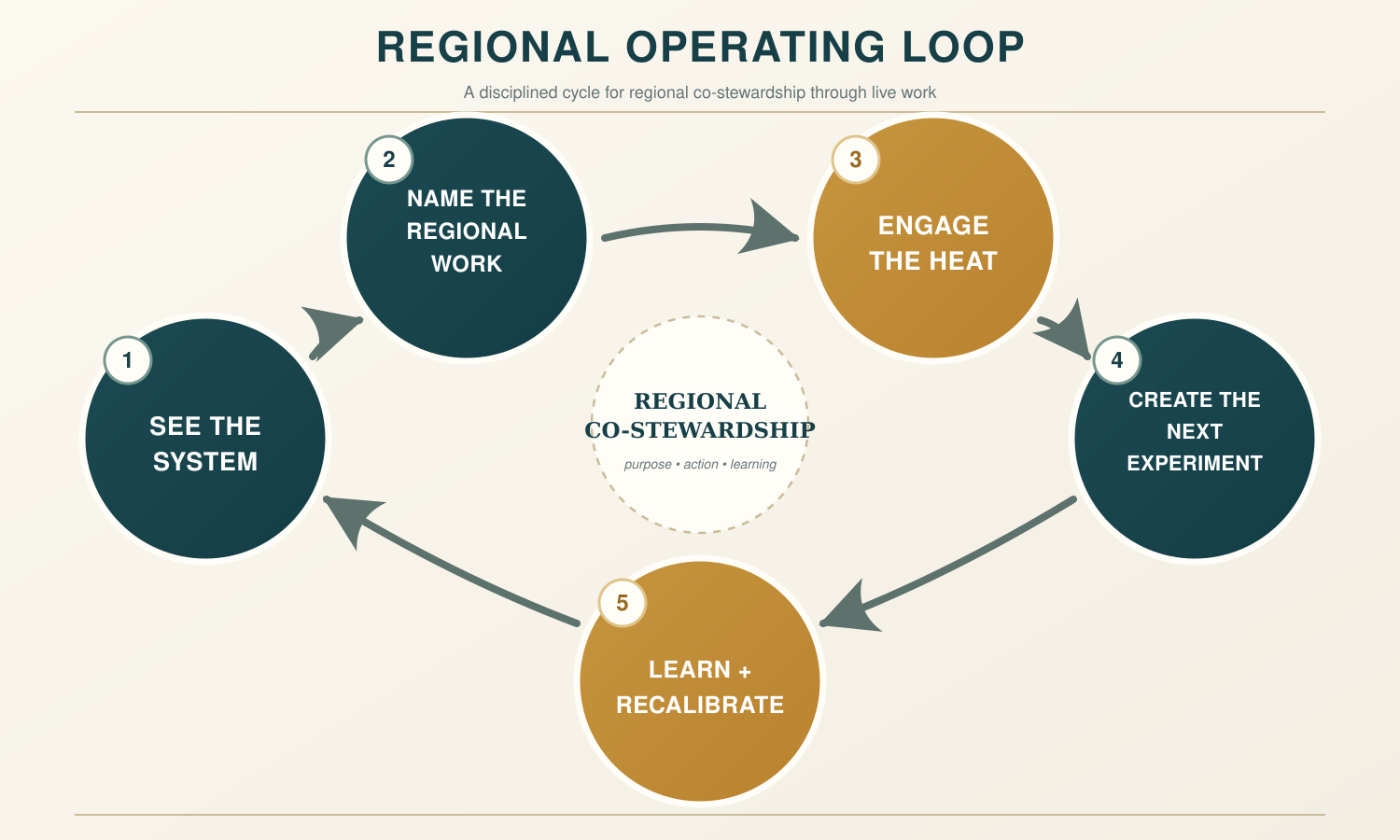
Enter through one priority already carrying consequence.
Growth, access, patient flow, capital, workforce, quality variation, physician integration, technology, or a newly integrated hospital can become the practice field.
90-minute regional system inquiry
Map one issue, the relevant levels and flows, current blockages, the CEO network’s role, and one next experiment.
Regional CEO network diagnostic
Interviews, a focused survey, meeting observation, and operating-rhythm review identify patterns, strengths, risks, and priorities.
Live regional priority lab
A 90-day action-learning cycle advances the work while strengthening collective regional capacity.
Regional-president counsel
Confidential thought partnership around authority, CEO development, role, relationships, and consequential conversations.
Nested-system engagement
Align the regional president, CEO network, and selected hospital executive teams around a shared objective.
Can Your CEO Network Carry the Region?
Use the brief privately or share it with a senior sponsor or CEO colleague.
Open the brief →Bring one issue that must move across hospitals.
We can examine what the current regional system can carry, where integration is concentrated, and what one disciplined experiment could reveal.
Begin a private working inquiry