
Your role is larger than leading your function.
Bring the full intelligence of your domain while helping the executive team see the whole, integrate competing realities, and lead the enterprise together.

Functional excellence and enterprise co-stewardship.
As a functional leader
- Protect professional and operational integrity
- Bring differentiated expertise
- Deliver functional results
- Develop the function
- Name risks visible from your domain
As an enterprise co-steward
- Help the team hold the whole
- Integrate rather than merely represent
- Own effects beyond the function
- Work tradeoffs directly with peers
- Strengthen the leadership system itself
The movement is not from functional responsibility to generalized collective responsibility. It is from functional responsibility alone to functional and enterprise responsibility held together.
The CEO can shape the conditions. Executives must learn to inhabit them.
The Executive Human System™ is constituted through what members notice, say, protect, integrate, escalate, circulate, and learn.
Leadership distributed across team members is positively associated with team effectiveness, especially in complex work. This does not erase hierarchy; it expands the team’s capacity to notice, influence, coordinate, and take responsibility.12
Three reasons you may be here.
I am developing independently
Build broader enterprise capacity, prepare for a larger role, or strengthen how you contribute to your current executive team.
Follow the learning pathMy CEO or team sent me here
Understand what the Executive Human System™ means, why the work matters, and what may be asked of you.
Begin the orientationMy team is actively engaged
Access shared language, preparation, live-heat practices, experiments, and between-session learning.
Client learningGreater enterprise responsibility can initially feel like reduced clarity.
You may experience more exposure of assumptions, less certainty before action, more peer challenge, and tension between representing your function and holding the whole.
This is not an invitation to become less decisive. It is an invitation to develop a wider repertoire—to see your own frame, hold multiple realities, and then act with greater precision.618
What remains
Expertise, standards, accountability, execution, role authority, and functional performance.
What expands
Inquiry, integration, systems awareness, stakeholder attention, learning through consequences, and responsibility for the vitality of the whole.
Eight practices that make the team more capable.
These are not personality traits. They are practices that can be tested in real meetings, decisions, relationships, and live enterprise work.
Carry both
Hold functional integrity and enterprise consequences at the same time.
Advocate without over-identifying
Offer your best judgment while remaining able to see beyond it.
Inquire without surrendering judgment
Use genuine inquiry to expand intelligence, not to avoid a position.
Receive challenge
Let disagreement improve the work rather than become a threat to status.
Use authority precisely
Know what belongs to you, what belongs between peers, and what belongs to the CEO.
Surface weak signals
Bring stakeholder costs, operational strain, and uncertainty early enough to matter.
Enable across boundaries
Help colleagues and functions succeed where work is interdependent.
Develop the system
Take responsibility for how the team learns, repairs, and renews itself.
Move from understanding the idea to changing how you lead.
Three moments of attention.
Use these prompts before, during, and after a consequential executive conversation.
Before
- What whole are we responsible for holding?
- What can my function see that the team needs?
- Where might I be overly identified with my frame?
- Which stakeholder voice is missing?
During
- Are we clear about the kind of work?
- Am I advocating, inquiring, or integrating?
- What is not being said?
- Are authority and ownership clear?
After
- What did we produce?
- What did our way of leading contribute?
- What must circulate into organizational life?
- What will we test next?
How are you contributing to the Executive Human System™?
This brief reflection identifies an orientation for inquiry. It does not assign an action logic or diagnose development.
Help the hospital lead locally and participate intelligently in the wider system.
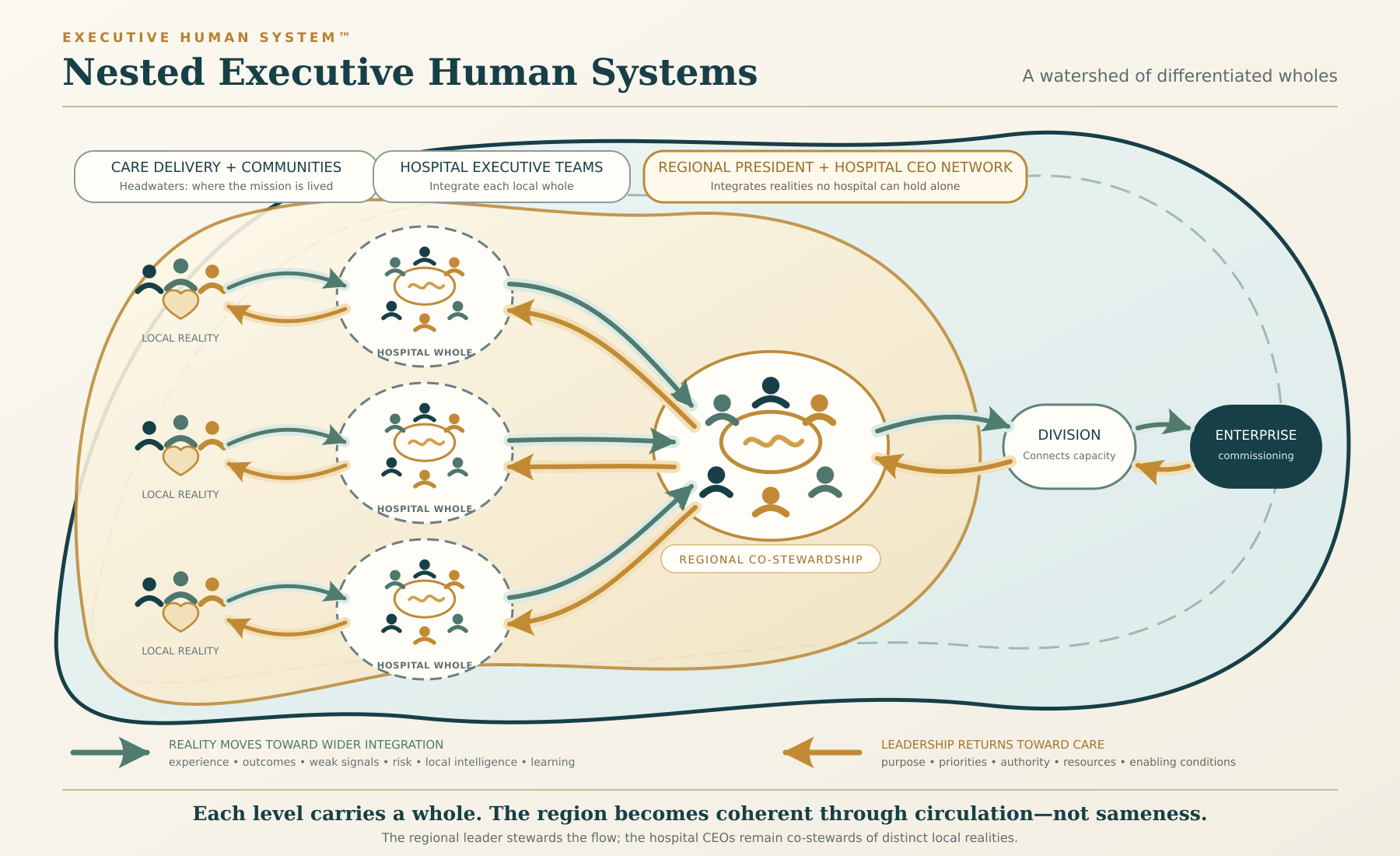
Your function is part of the hospital whole. The hospital is part of a regional whole. Enterprise co-stewardship includes helping local intelligence travel upward and outward—and helping wider intent become meaningful in operational reality.
- Surface local consequences before they become resistance or crisis.
- Distinguish nonnegotiable purpose from adaptable implementation.
- Share learning and capability beyond your home unit.
- Help your CEO carry both hospital advocacy and regional stewardship.

Do not become the informal second CEO.
Enterprise co-stewardship means strengthening collective capacity under clear authority—not assuming the CEO’s role, bypassing peers, or centralizing the team around yourself.
Read the practice guide